Architecture
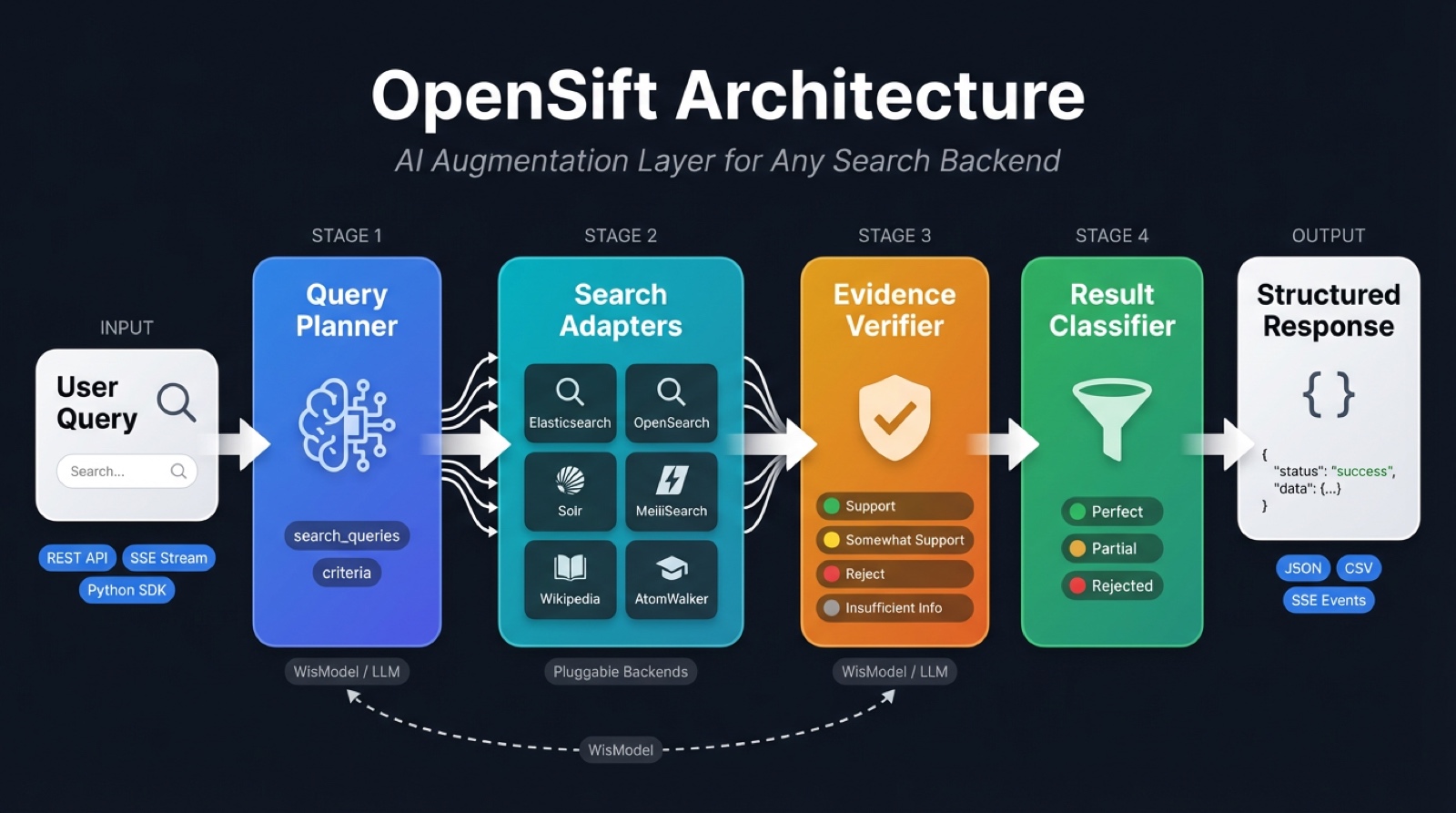
Pipeline Overview
OpenSift follows a four-stage pipeline:
graph TD
    A[User Query] --> B[Query Planner]
    B -->|search queries + criteria| C[Search Adapters]
    C -->|raw results| D[Evidence Verifier]
    D -->|assessments| E[Result Classifier]
    E --> F[Structured Response]

    W[WisModel LLM] -.->|powers| B
    W -.->|powers| D
Stage 1: Query Planner
Takes a natural language question and generates via LLM:
- Search queries — 2–4 precise keyword phrases for the search backend
- Screening criteria — 1–4 quantified rules, each with type, description, and weight
Stage 2: Search Adapters
Dispatches the generated queries to one or more search backends via the adapter pattern. Results are normalized to a standard schema.
Stage 3: Evidence Verifier
Verifies each search result against each criterion using the LLM:
| Assessment | Meaning |
|---|---|
| Support | Criterion clearly met, with cited evidence |
| Somewhat Support | Partially relevant but not fully met |
| Reject | Clearly does not meet the criterion |
| Insufficient Information | Not enough info to judge |
Stage 4: Result Classifier
Automatically classifies based on verification results:
| Classification | Rule |
|---|---|
| Perfect | All criteria are Support |
| Partial | At least one non-time criterion is Support or Somewhat Support |
| Reject | All criteria are Reject, or only time criteria pass |
Project Structure
opensift/
├── src/opensift/
│   ├── core/                     # Core AI pipeline
│   │   ├── engine.py             # Orchestrator (Plan → Search → Verify → Classify)
│   │   ├── planner/planner.py    # Query planning
│   │   ├── verifier/verifier.py  # Result verification
│   │   ├── classifier.py         # Classification
│   │   └── llm/                  # LLM client + prompt templates
│   ├── adapters/                 # Search backend adapters (pluggable)
│   │   ├── base/                 # Abstract interface
│   │   ├── atomwalker/           # AtomWalker academic search
│   │   ├── elasticsearch/        # Elasticsearch
│   │   ├── opensearch/           # OpenSearch
│   │   ├── solr/                 # Apache Solr
│   │   ├── meilisearch/          # MeiliSearch
│   │   └── wikipedia/            # Wikipedia
│   ├── models/                   # Data models (Pydantic)
│   ├── client/                   # Python SDK
│   ├── api/                      # REST API (FastAPI)
│   ├── config/                   # Config management
│   └── observability/            # Logging
├── tests/
│   ├── unit/                     # Unit tests (mocked)
│   └── integration/              # Integration tests (Docker)
├── deployments/docker/           # Docker Compose files
├── docs/                         # Documentation (this site)
└── pyproject.toml
Data Flow
sequenceDiagram
    participant U as User
    participant API as REST API
    participant E as Engine
    participant P as Planner
    participant S as Search Adapter
    participant V as Verifier
    participant C as Classifier

    U->>API: POST /v1/search
    API->>E: execute(query, options)
    E->>P: plan(query)
    P-->>E: search_queries + criteria
    E->>S: search(queries)
    S-->>E: raw results
    E->>V: verify(results, criteria)
    V-->>E: assessments
    E->>C: classify(assessments)
    C-->>E: perfect / partial / reject
    E-->>API: structured response
    API-->>U: JSON response